

Digital nomad visas: Countries with easiest requirements

Remote work has changed how people live and work. Today, many jobs can be done from a laptop and an internet connection. You no longer need to sit in an office to earn a living. This shift has allowed people to travel more, live abroad, and still keep their jobs.
As remote work grew, many countries saw an opportunity. They wanted to attract skilled workers who earn money online but spend it locally. This is why digital nomad visas were created. These visas give remote workers legal permission to live in another country while working for a company or clients outside that country.
According to one report, over 50 countries1 now provide digital nomad visas or other special permits for remote workers.
This article will explain what a digital nomad visa is, how it works, and who it is for. You will also learn about countries with digital nomad visas that have simple and flexible rules. By the end, you will understand how to get a digital nomad visa and decide which option may work best for you.
What is a digital nomad visa?
A digital nomad visa is a special type of remote work visa. It allows people to live in a foreign country while working online for an employer or clients based elsewhere. You earn your income outside the country where you dwell.
This visa is for people who don’t need a local job. As long as you can work from your laptop, you may qualify.
How is it different from other visas?
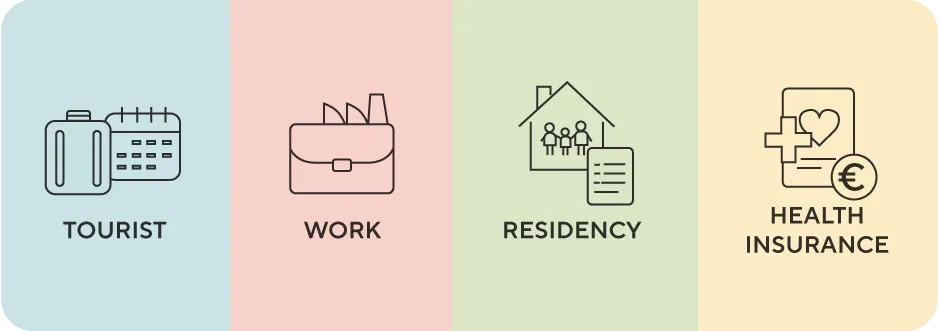
Digital nomad visas are often confused with other visa types. Here’s how they differ:
A tourist visa is for short visits. It is meant for vacations, not work. Most tourist visas last 30 to 90 days2. Working on a tourist visa is often not allowed, even if your job is online. A digital nomad visa, on the other hand, clearly allows remote work. It’s for longer stays and legal online employment.
A work visa usually requires a local employer3. You must be hired by a company in that country. The company often sponsors the visa. However, a digital nomad visa doesn’t require an in-country employer. Your job or clients stay abroad.
A residency permit4 is typically for people who want to settle long-term. It may lead to permanent residence or citizenship. At the same time, digital nomad visas are temporary. They allow you to stay for a limited time, often up to two years.5
Who is a digital nomad?
Now that you know what is a nomad visa and how it differs from other visas, let’s jump to know who exactly can be a nomad.
A digital nomad is someone who works online and is not tied to one location. This may include:
- Freelancers
- Remote employees
- Online business owners, and
- Consultants.
If your work only needs the internet, you may be considered a digital nomad.
How digital nomad visas work
Digital nomad visas are designed to be simple and flexible. Most countries offer them to individuals who want to live legally and work online.
Many digital nomad visas are valid for 6 to 24 months. Some countries issue them for one year, while others offer two years from the start.
Many countries allow extensions. This means you can apply to stay longer if you still meet the requirements. Some visas can be renewed once, while others can be renewed multiple times.
In many cases, yes6. Several countries allow spouses and children to join the main visa holder. You may need to show a higher income if you bring dependents.
Generally, no. Most digital nomad visas do not allow you to work for local companies. The goal is for you to bring foreign income into the country, not compete in the local job market.
Common digital nomad visa requirements
While rules differ by country, most countries offering digital nomad visas ask for similar documents. Here’s what you’ll typically need.
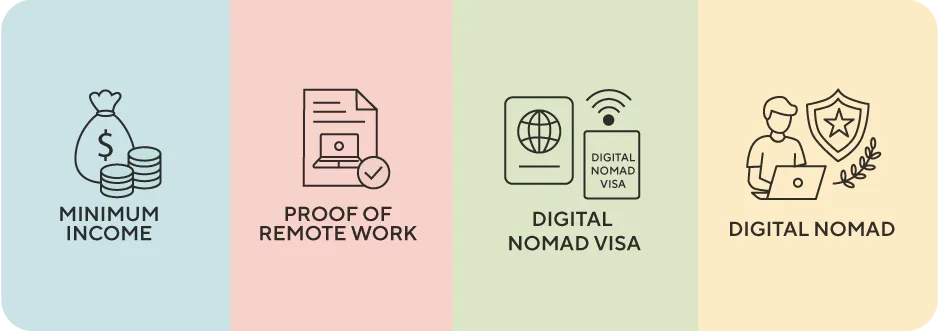
Minimum income requirements
Some places set a low-income limit, which is great for freelancers and solo workers. Other countries ask for higher earnings, especially in popular cities.
You may need to show recent bank statements, pay slips, or tax records. In some cases, countries want proof that your income is stable, not just a one-time payment. Meeting the income requirement is often the most important part of the application.
Proof of remote work or self-employment
You must also show that you work remotely. This means your job or business is based in another country.
This step helps countries make sure you don’t plan to work locally.
Health insurance
Health insurance is required in almost all digital nomad visa programs. The insurance must cover your entire stay.
In most cases, it needs to include medical care, hospital visits, and emergency treatment. Some countries also require coverage for medical evacuation. This protects both you and the host country if something goes wrong.
Without proper insurance, your application may be rejected.
Clean criminal record
Many countries ask for a police clearance certificate from your home country. This document shows that you do not have a serious criminal history.
The certificate is often required to be recent and sometimes needs to be officially translated. This helps countries ensure public safety.
Application fees
There is usually a visa application fee. The cost depends on the country. Some charge a small amount, while others have higher processing fees.
Countries with the easiest digital nomad visa requirements
Not all digital nomad visas are equal. Some are much easier to get than others. When we say “easy,” we look at a few key factors.
- First, low-income requirements matter. Countries with lower income thresholds are easier for freelancers and new remote workers.
- Second, online applications make the process smoother. Many countries now allow you to apply without visiting an embassy.
- Quick processing times also help. Some visas are approved in weeks instead of months.
- Finally, minimal documentation makes a big difference. Fewer papers mean fewer delays.
These factors help identify the easiest digital nomad visas available today.
Easiest digital nomad visa countries
Below is a quick comparison of some of the most popular (and easiest) digital nomad visa options. These are well-known countries with digital nomad visas and clear application rules.
| Country | Minimum income | Visa length | Processing time | Family allowed | Notes |
|---|---|---|---|---|---|
| Portugal | €3,680/month8 | 1–2 years | 60–90 days | Yes | Path to residency |
| Spain | €2,762/month9 | 1 year | 10–45 days | Yes | New digital nomad law |
| Croatia | €3,295/month10 | 1 year11 | 30–45 days | Yes | No local tax |
| Estonia | €4,500/month12 | 1 year | 30 days | Yes | One of the first |
| Georgia | $2,000/month13 | 1 year | 10–20 days | Yes | Very simple process |
| Mexico | $4,460/month14 | 1 year | 30–45 days | Yes | Flexible rules |
| Colombia | $650/month15 | 2 years16 | 15–30 days | Yes | Very low income |
| Costa Rica | $3,000/month17 | 1 year | 15–30 days | Yes | Stable environment |
| Bahamas | Not officially specified, but expect to have up to $3,500/month18 | 1 year | 5 days | Yes | Premium option |
Countries like Colombia and Georgia stand out for low-income needs. Portugal and Spain are popular for those who want long-term options.
Countries that don’t officially offer digital nomad visas (but are often confused)
Not every popular country has a digital nomad visa. Some places are talked about a lot online, but they don’t offer an official remote work visa. This often causes confusion for people trying to plan long-term stays.
Here are the most common examples.
United States
The United States doesn’t have a digital nomad visa or a remote work visa. There is no visa category that allows foreign nationals to dwell in the U.S. and work online for a foreign company.
United Kingdom
The UK also does not offer a digital nomad visa. No visa allows long-term residence for people working remotely for overseas employers.
Visitors usually enter the UK on a Standard Visitor visa21, which allows short stays (up to 6 months). However, this visa doesn’t support long-term remote work arrangements.
Canada
Canada is often cited as nomad-friendly, but– like the US and the UK– it doesn’t have a dedicated digital nomad visa.
Canada’s immigration categories focus on study, work permits, and permanent residence.
If a country does not have an official digital nomad visa, you risk overstaying or violating visa rules. That’s why choosing from countries that offer digital nomad visas is the safest option for long-term remote living.
Who should consider a digital nomad visa?
A digital nomad visa is not only for influencers or full-time travelers. It is, in fact, for real people with real jobs who want more freedom without breaking visa rules.

Here are the groups that benefit the most.
Freelancers and independent contractors
Freelancers are one of the best fits for digital nomad visas. If you work with clients online and get paid from abroad, these visas give you legal permission to live overseas.
Instead of worrying about tourist visa limits, freelancers can stay longer and focus on work. This is especially helpful for designers, writers, developers, and consultants.
Remote employees
If your employer allows you to work remotely, a digital nomad visa can give you location freedom. You keep your job, your salary, and your employer — only your location changes.
Some countries require a letter from your employer confirming remote work. This makes it clear that your income comes from outside the host country.
Startup founders and online business owners
Startup founders who run online businesses can also benefit. If your company operates digitally and earns income from global customers, you may qualify.
This is useful for founders who want to reduce living costs, explore new markets, or simply work in a different environment without relocating their business.
Long-term travelers
If you enjoy slow travel, a digital nomad visa is a better option than jumping between tourist visas. It allows you to stay legally for months or even years.
You can rent a home, open local accounts in some cases, and settle into daily life instead of rushing from country to country.
This is why many long-term travelers now look for the easiest digital nomad visas instead of relying on tourist entries.
How BOSS Revolution helps digital nomads stay connected
Living abroad doesn’t mean losing touch with home. Digital nomads rely heavily on tools that keep them financially and emotionally connected.
BOSS Revolution helps digital nomads manage daily needs. You can send international money transfers quickly and securely. This helps pay rent, support family, or move funds between accounts.
Mobile top-ups make it easy to stay connected without changing numbers. You can keep in touch no matter where you are.
Most importantly, it helps you stay close to family and friends back home while living abroad.
Final thoughts: choosing the right digital nomad visa
There is no single best digital nomad visa option for everyone. The right visa depends on your income, goals, and lifestyle. Some people want low costs, while others want long-term residence options.
Also, always check official government websites for updated income thresholds and tax and legal obligations before applying. Rules can change, and requirements may differ by nationality.
With the right planning, choosing from the easiest digital nomad visas can open the door to a new way of living and working abroad.
Sources: all third party information obtained from applicable website as of January 30, 2026
-
https://www.untourism.int/news/almost-half-of-all-global-destinations-now-offer-digital-nomad-visas
-
https://travel.state.gov/content/travel/en/us-visas/tourism-visit/visitor.html/visa#:~:text=Additional%20Information,until%20you%20have%20a%20visa.
-
https://travel.state.gov/content/travel/en/us-visas/immigrate/employment-based-immigrant-visas.html
-
https://www.sciencedirect.com/topics/social-sciences/residence-permit
-
https://immigrantinvest.com/digital-nomad-visa/
-
https://www.germany-visa.org/digital-nomad-visa/
-
https://assets.kpmg.com/content/dam/kpmgsites/xx/pdf/2022/09/GMS-DigitalNomad-RemoteWork-TrackerMap.pdf.coredownload.inline.pdf
-
https://theblueportugal.com/portugals-visas/portugal-d8-visa-and-residency/#:~:text=The%20Visa%20D8%20Digital%20Nomad,a%20longer%20stay%20in%20Portugal.
-
https://immigrantinvest.com/spain-digital-nomad-residence/
-
https://mup.gov.hr/aliens-281621/stay-and-work/temporary-stay-of-digital-nomads/286833
-
https://mvep.gov.hr/consular-information-130483/temporary-stay-of-foreigners/264503
-
https://www.e-resident.gov.ee/nomadvisa/
-
https://www.relocate.world/articles/georgia-digital-nomad-visa
-
https://www.upwork.com/resources/digital-nomad-visa-countries
-
https://brighttax.com/blog/colombia-digital-nomad-visa-complete-guide/
-
https://www.cancilleria.gov.co/v/nomadadigital
-
https://www.visitcostarica.com/digital-nomads/requirements
-
https://www.jobbers.io/digital-nomad-visa-guide-50-countries-ranked-for-freelancers-taxes-internet-cost/
-
https://travel.state.gov/content/travel/en/us-visas/tourism-visit/visitor.html/visa
-
https://travel.state.gov/content/travel/en/us-visas/tourism-visit/visa-waiver-program.html
-
https://www.gov.uk/standard-visitor
This article is provided for general information purposes only and is not intended to address every aspect of the matters discussed herein. The information in this article is not intended as specific personal advice. The information in this article does not constitute legal, tax, regulatory or other professional advice from IDT Payment Services, Inc. and its affiliates (collectively, “IDT”), and should not be taken or used as such by any individual. IDT makes no representation, warranty or guaranty, whether express or implied, that the content in this article is current, accurate, or complete. You should obtain professional or other substantive advice before taking, or refraining from, any action on the basis of the information in this article.
