

BOSS Revolution calling statistics & analytics (2015–2025): trends, insights & user behavior

International calling has evolved, due to the adoption of digital communication tools like messaging applications. However, while chat or text messaging has grown, voice communication hasn't disappeared – it still remains an important method of communication
To understand these shifts, BOSS Revolution analyzed its consumer voice product data. Focusing on the behavior of six million customers, BOSS Revolution compared patterns from 2015, 2020, and 2025 and explored how technology, global events, and everyday habits continue to shape the way voice communication is used to connect with others.
The data BOSS Revolution used is backed by IDT Corporation, a multinational corporation with nearly three decades of service in the telecommunications industry. Since 1990, IDT has been providing and improving communication services, including launching the innovative BOSS Revolution platform in 2008 to meet the increasing demands of consumers worldwide. Extensive telecom data analytics provide a clear picture of global calling patterns today.
Key findings: strongest insights
Before delving deeper, here are the most important research insights gleaned from BOSS Revolution’s analysis of IDT data:
- Talk time on the BOSS Revolution mobile app increased to 71% of total voice traffic, a sharp increase from the 14% in 2015. Customers have migrated to apps instead of calling cards.
- The average length of call has only slightly declined over the last decade. This shows that while consumers now have access to a portfolio of communication methods, when they do make calls, they still like to have nice, long conversations with their loved ones.
- Data from BOSS Revolution shows that there has been no significant change in peak call. Consumers have clear preferences when they want to talk to friends and families: evenings and weekends.
- On average, each BOSS Revolution user now has approximately three more calling contacts than they did ten years ago. Users have a wider range of contacts.
- Major disruptions, such as catastrophic weather events, trigger spikes in call volume among BOSS Revolution users, underscoring the importance of voice in times of crisis.
To better understand these trends, you need to look at how calling has evolved over time.
The evolution of calling: from calling cards to AI voice
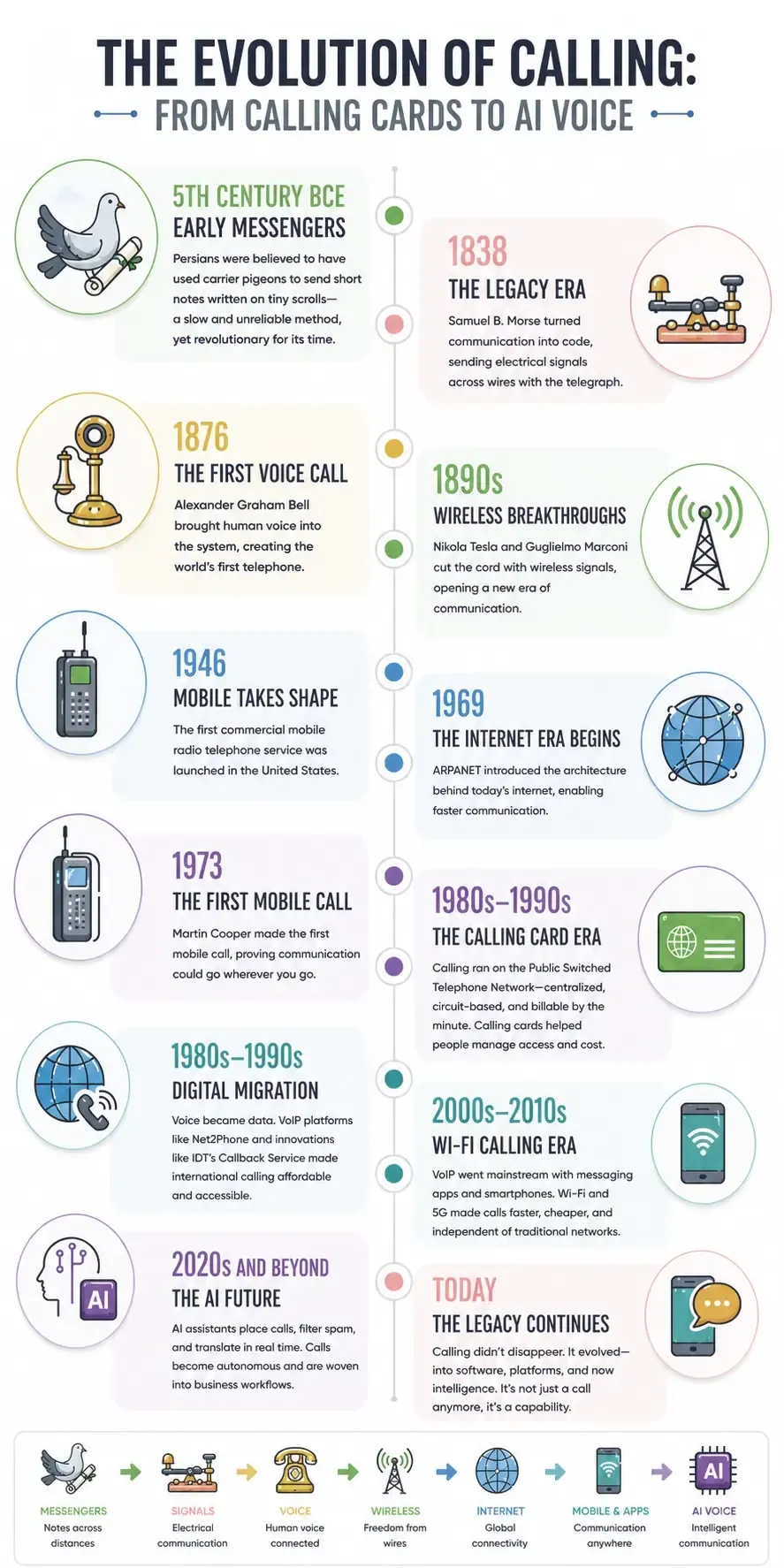
Throughout centuries, people have found new ways to communicate across distances — from using carrier pigeons to the telegram to the communication systems powered by technology today.
The legacy era
After Samuel Morse discovered how to turn words into electrical signals and Alexander Graham Bell turned those signals into a telephone system, innovation in telecommunications moved in bursts.
Nikola Tesla and Guglielmo Marconi cut the cord with wireless signals in the 1890s, but it took five decades before the first commercial mobile radio telephone service was offered in the United States. Then, it took two more decades until ARPANET introduced the architecture behind today’s internet.
Although mobility soon followed, with Martin Cooper making the first mobile call in 1973, calling in the 20th century still relied on the Public Switched Telephone Network — centralized, circuit-based, and ruthlessly billable. Every minute had a cost, and distance compounded it.
Digital migration
In the 1980s, the internet made hybrid communication possible with voice, video, and messaging functioning inside the same ecosystem. This, essentially, broke the economics of voice calls. Early VoIP providers were able to offer cheaper international calls. New infrastructure also enabled telecom companies to provide better features at lower prices. In 1991, for example, IDT lowered call charges and revolutionized international call costs through its Callback Service.
Wi-Fi calling era
In the early 2000s, VoIP hit mainstream—and so did messaging apps. Facebook, Instagram, WhatsApp, and other social media platforms offered messaging in a borderless digital world. User loyalty soon shifted from phone carriers to mobile apps.
With 5G technology entering the picture a decade later, wireless communication also became faster and more reliable, eventually removing dependency on traditional PSTN. If you had the internet, you had a voice.
The AI future
Today, calling continues to evolve. AI is changing the role of the user. People no longer initiate every call; they just supervise outcomes. AI assistants can now place automated calls, filter spam, and translate in real time. Calls become autonomous and are increasingly woven into business workflows.
What can you observe in this evolution?
Calling didn’t disappear. It dissolved into software, into platforms, and, now, into intelligence. While many still view it in the traditional sense, it is now a capability that’s embedded in most communication tools.
Call pattern analysis: 2015 vs 2020 vs 2025
Here are the latest phone call statistics and mobile usage analytics based on data from the BOSS Revolution. They show shifts in communication behavior among users. The large dataset (6M+ users per year) makes these trends statistically meaningful and the 10-year time frame ensures the results are historically robust.
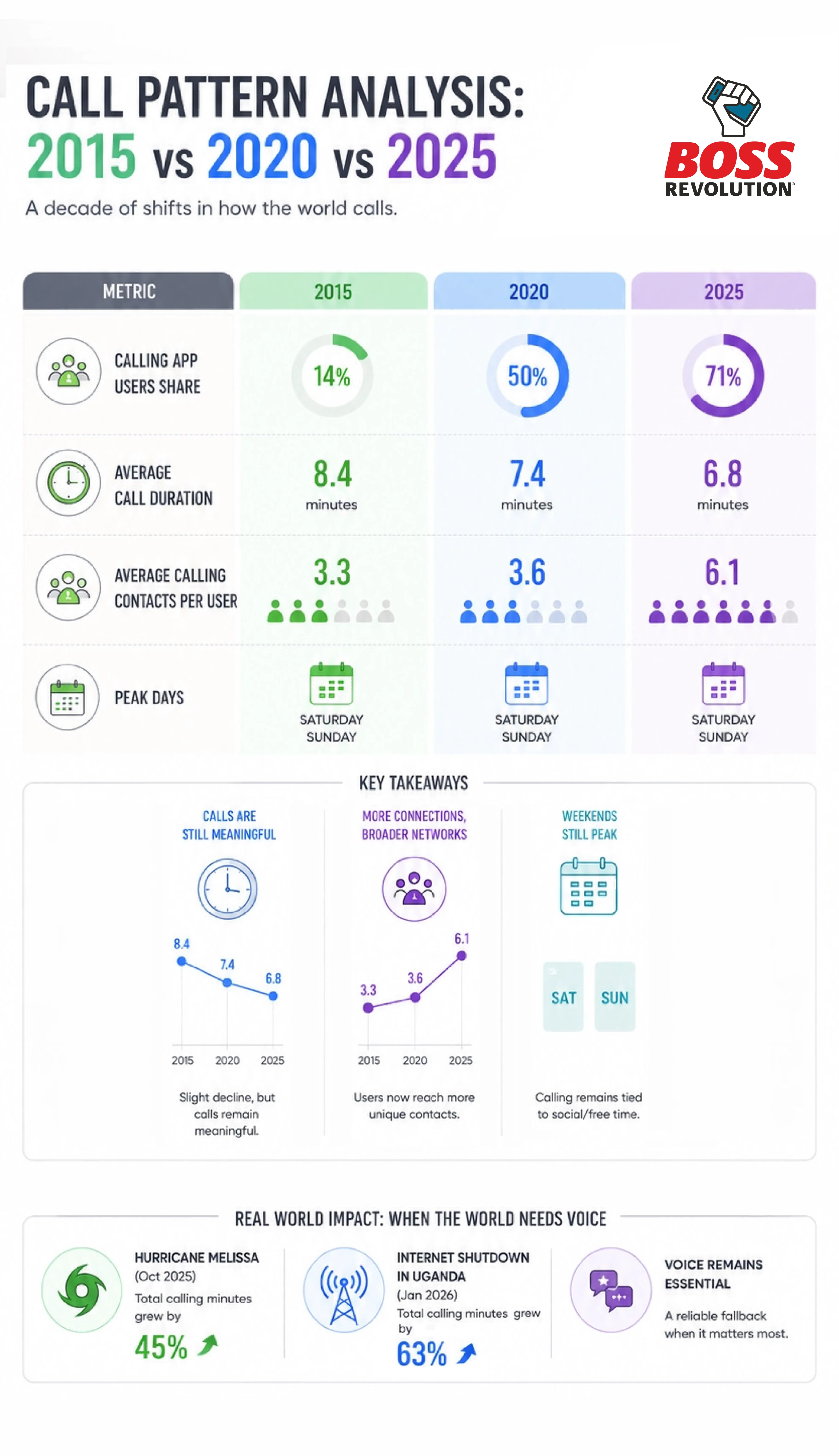
| 2015 | 2020 | 2025 | |
|---|---|---|---|
| App driven Long-Distance Calls | 14% | 50% | 71% |
| Average call duration | 8.4 minutes | 7.4 minutes | 6.8 minutes |
| Average calling contacts per user | 3.3 | 3.6 | 6.1 |
| Peak days | Saturday Sunday |
Saturday Sunday |
Saturday Sunday |
Calling app users share
The 57% increase in BOSS Revolution calling app users from 2015 to 2025 shows a massive shift from traditional means of placing long-distance phone calls. What you can see here is a large-scale behavioral migration and not a mere niche shift.
Adoption accelerated sharply between 2015 and 2020 and continues to grow, albeit at a slower pace. The recent slowdown in growth is likely due to saturation, as the majority of users have already shifted to calling apps.
Average call duration
Average call durations have only slightly declined over the years. A decrease of 1.6 minutes over 10 years is negligible. With averages above six minutes, calls remain meaningful despite the presence of other communication channels.
Average calling contacts per user
The number of calling contacts per BOSS Revolution user has nearly doubled, with much of the growth occurring between 2020 and 2025. More users are now calling a greater number of unique contacts, in spite of texting or messaging upticks. This suggests broader but possibly less frequent interactions per contact, considering the decline in the number of calls.
Peak days
Peak calling days have remained unchanged. Calls remain concentrated on weekends, indicating that most calls are tied to social or free time. This suggests that calls are mostly used to maintain connections with family and friends.
The importance of long distance voice during natural disasters
During major natural disasters and network disruptions, call volume and duration can increase sharply within the BOSS Revolution network. Global instability is clearly visible in BOSS Revolution performance data.
When Hurricane Melissa struck Jamaica, Cuba, and the Bahamas in late October 2025, total calling minutes among BOSS Revolution users grew by 45%. Similarly, during a nationwide internet shutdown in Uganda in January 2026, total calling minutes increased by 63%.
The next sections break down data from other sources for a broader picture of global calling. These statistics align with study findings.
Telecom user behavior analytics: who makes calls
There are distinct usage patterns across demographics. Age, gender, and other factors influence how many phone calls are made a day. These insights can be used for telecom customer segmentation.
Women make fewer but longer calls than men.1,3
Research on domestic phone use2 published in Social Psychology Quarterly suggests distinct behavioral tendencies based on gender. Calls to women are mostly relational, involving talks about personal, social, or everyday life. Calls to men, on the other hand, appear to be more task-focused and tend to be shorter.
Young people call more frequently and stay on calls longer.
According to YouGov Surveys4, young people (ages 18 to 24) tend to call family and friends more often, with 9% of those in the age group spending more than two hours on voice calls in a typical day5. A Pew Research survey6 also showed a steady drop-off in calling frequency, with young callers averaging ten calls per day and older users (65+) calling only an average of three calls per day4.
The majority of phone users are frequent short callers4.
Surveys from YouGov and Pew Research also suggest that the majority of phone users treat calls as brief touchpoints for work-related communication or for keeping in touch with family and friends7. Approximately 52% of Americans spend less than 15 minutes a day on phone calls. Long-duration callers are quite rare with less than 10% of phone users spending more than two hours on calls.
Work-related calls are shorter and more transactional.
Most voice calls are personal in nature, made to friends and family. While most of them are short calls, they are generally longer than work calls, with some calls lasting over an hour. In contrast, only 3% of work calls exceed 30 minutes, according to YouGov4.
When people call: time, days & behavioral patterns
People’s calling habits tend to follow patterns based on purpose and context, as revealed in a case study8 conducted by researchers from the University of Tartu. Here’s what an analysis of telecom data showed:
- Weekday calls are shorter and more work-related, with some outliers in the early morning and evening for personal calls. Weekend calls, on the other hand, are more personal, longer, and socially driven.
- Call volume fluctuates throughout the day, with personal calls having peak hours from late afternoon to early evening.
- Call activity increases during holidays, cultural events, and social gatherings. This implies the importance of voice calls in connecting with loved ones and coordinating social events.
A survey by TransUnion9 reflects similar insights. Voice calls tend to spike during major events when people rely on them as a real-time response tool. In fact, a survey of U.S. consumers9 indicated that 55% of users consider their phones important for calling in urgent circumstances, such as getting assistance during natural disasters.
These findings align with insights from the BOSS Revolution global calling services study, particularly the surge in calls observed during Hurricane Melissa and the Uganda internet shutdown.
These behavioral patterns can help with more accurate customer segmentation in the telecom industry, enabling providers to offer better services that are tailored to actual usage.
Global calling corridors: where people call most
The United States has long been the center of international voice traffic. In 2002, 40.3 billion minutes out of the 155 billion minutes of international telephone calls were made from the US10, according to the Guinness World Records. In 2015, seven of the ten largest international call routes came from the United States, with 7.7% of calls being from the US to Mexico and 3.2% from the US to India11,12.
Today, global calling patterns are more distributed, but still strongly shaped by migration and the need to maintain cross-border social and family connections.
Top regions to call:
- Central America (Guatemala, Honduras, El Salvador) and Mexico
- Africa (Nigeria, Ethiopia, Kenya, Eritrea, Ghana)
- Caribbean (Haiti, the Dominican Republic, Jamaica, and Cuba)
Only 5% of call volume is in Europe, Asia, Canada, Oceania, North America.
Top calling countries (more than 100k callers)
These countries have the highest number of active international callers, registering over 100,000 users:
- Guatemala
- United States
- Dominican Republic
- Nigeria
- Ethiopia
- Honduras
- El Salvador
- Haiti
- Jamaica
- Ghana
In many of these countries, the lack of digital infrastructure and poor mobile network quality, including reliable 5G coverage, contribute to voice call volume and duration.
The most expensive places to call
Using the BOSS Revolution platform, calls to the United States and the United Kingdom cost less than 2 cents per minute. But there are certain places that can be quite expensive to call. Many of these places are remote regions with limited infrastructure, while a few are not countries in the usual sense.
| Area | BOSS Revolution rates (per minute) |
Other wireless or digital telecom providers (per minute rates on top of paid plans)13 |
|
|---|---|---|---|
| Satellite networks (used in ships, planes, or expeditions) | Inmarsat | $5 | $8.25 |
| Iridium | $5 | Not supported | |
| Thuraya | $5 | Not supported | |
| Extremely remote islands (small island nations with limited infrastructure) | Solomon Islands | $5 | $1.20 |
| Saint Helena | $2.835 | $1.32 | |
| Tokelau | $2.50 | $1.96 | |
| Kiribati | $1.50 | $1.16 | |
| Nauru | $1.50 | $1.96 | |
| Tonga Islands | $1.061 | $1.53 | |
| Vanuatu | $1.061 | $2.41 | |
| Western Samoa | $1.061 | $0.63 | |
| Maldives | $1.00 | $1.45 | |
| Sao Tome & Principe | $1.00 | $1.59 | |
| Other locations (areas with regulatory, political, or infrastructure constraints) | Antarctica | $1.00 | $1.20 |
| East Timor | $1.00 | $1.79 | |
| Cuba | $0.768 | $0.75 | |
Text messaging vs calling: is voice really dying?
A study14 conducted more than a decade ago showed that texting is preferred over calling across age groups and genders. Calls were mostly reserved for romantic partners or important conversations.
A more recent study reveals a similar pattern. According to a Uswitch survey15, young people today (ages 18 to 34) prefer social media (48%) and voice messages (37%) as their communication channels. Yet, more than half of them (53%) indicated that they would be offended if someone close to them didn’t phone them to share happy news.
So, voice isn’t dying - it has simply transformed into a high-intent communication channel. While its use is becoming increasingly secondary to messaging platforms, calling is still relevant today.
What drives call quality & duration
Call quality is influenced by several factors, including network quality, internet speed, geographic routing, carrier performance, infrastructure, and device capabilities.
IDT uses advanced analytics for telecom optimization, which ensures high call quality at all times.
Survival analysis, one of the most used telecom analytics use cases, is used for churn prediction, carrier issue detection, and quality improvement. This statistical method analyzes time-to-event data and improves call quality by:
- Detecting weak carrier routes
- Predicting call failures
- Optimizing call routing in real time
For example, if several calls to a specific region show a sharp drop-off after two minutes, survival analysis flags a potential carrier issue. Voice traffic is then rerouted appropriately.
Future of calling: what will change by 2030–2050
The international call services market is expected to grow from $1.72 billion in 2025 to $2.54 billion in 203016. This projection indicates that market leaders are confident that global calling will remain relevant in the next few years.
However, you can expect the future of calling to be shaped by a markedly different landscape—one where traditional circuit-switched networks are replaced by internet-based infrastructure and hybrid communication systems.
Here’s what you’ll likely see in the coming years:
1. VoIP will become the dominant form of voice communication17.
Traditional phone networks (PSTN) are being used less and less each year as more people switch to mobile phones and internet-based calls (VoIP). TeleGeography data shows that there were around 1.22 billion landlines worldwide in 2006, but that has since dropped to just 407 million in 2024. VoIP lines, on the other hand, have reached about 447 million in the same year. If this trend continues, VoIP will be far more common than landlines by 2031.
2. More people will continue to use calling apps to make international voice calls.
According to Statista18, global mobile voice traffic has remained the same at only 0.23 exabytes per year since 2016. In contrast, mobile data traffic has increased tremendously, reaching almost 188 exabytes in 2025. However, this doesn’t mean voice calling is dead. A more likely explanation to this trend is because more people are now using calling apps like WhatsApp, Messenger, Zoom, and BOSS Revolution. Calls made through these apps count as data, not voice traffic. This shows voice traffic growth flattening while data traffic skyrockets.
3. Telecom companies will focus on 5G/6G expansion to meet voice call demands.
Aside from the use of calling apps, regular calls are increasingly carried over data networks, such as VoIP and VoLTE. Yet, existing infrastructure still has limitations. Ookla performance monitoring shows that although the fastest 5G networks already have high median download (994 Mbps) and upload (58 Mbps) speeds, latency remains high at 189 to 285 ms19. To improve the quality of international calls and optimize calling apps, telecom companies are prioritizing 6G expansion for faster speeds and lower latency.
4. International calling costs will decline in the future.
Along with the shift from PSTN to VoIP/VoLTE, the cost of international calls is likely to drop. VoIP providers typically offer per-minute rates that are 30% to 90%20 lower compared with traditional phone lines. Advances in technology and infrastructure will help push call costs lower as the operational costs of telephone and data networks also decrease.
5. AI will make calls smarter and faster.21
As AI technology becomes embedded in telecom systems, calls will become more efficient. AI assistants can pick up, respond to, or route calls for businesses. It can also filter spam, reduce waiting time, and tailor responses for more personalized communication. Along with voice tech, communication will become more accessible with real-time voice translations, speech-to-text, and text-to-speech features.
Conclusion
Voice is not disappearing. It is evolving. This is clear from historical statistics and projections by industry experts.
Although calling has undergone, and will continue to undergo, structural shifts over the past decades, it will continue to be a important method of communication Voice calling has gone from a standalone channel to being part of a portfolio of communication technologies including messaging, video, and now AI-assisted tools.
Looking ahead, the core function of voice calling will will remain even as the world around it changes. When human connection and trust are required, people will still dial a phone number.
Sources: all third party information obtained from applicable website as of June 3, 2026
-
https://www.sciencedirect.com/science/article/abs/pii/S016748701000142X
-
https://www.researchgate.net/publication/228583231_Gender-Specific_Use_of_the_Domestic_Telephone
-
https://bakadesuyo.com/2011/01/do-women-talk-on-the-phone-more-than-men/
-
https://yougov.com/en-us/articles/49894-how-long-do-americans-talk-on-calls-in-day
-
https://www.sellcell.com/blog/how-many-phone-calls-are-made-a-day/
-
https://www.pewresearch.org/internet/2010/09/02/cell-phones-and-american-adults/
-
https://www.pewresearch.org/internet/2010/09/02/part-2-cell-phone-communication-patterns/
-
https://www.researchgate.net/publication/337557532_Impact_of_Natural_and_Social_Events_on_Mobile_Call_Data_Records_-_An_Estonian_Case_Study
-
https://www.transunion.com/blog/five-survey-insights-on-consumer-calling-behavior#
-
https://www.guinnessworldrecords.com/world-records/78307-most-international-telephone-calls-country
-
https://scroll.in/article/687209/this-map-of-international-phone-calls-explains-globalisation
-
https://qz.com/290868/this-map-of-international-phone-calls-explains-globalization
-
https://www.att.com/scmsassets/upper_funnel/internet/international_calling_rates.pdf
-
https://www.sciencedirect.com/science/article/abs/pii/S0747563213004032
-
https://www.uswitch.com/media-centre/2024/04/Call-me-maybe-quarter-young-people-never-answer-phone/
-
https://www.thebusinessresearchcompany.com/report/international-call-services-global-market-report
-
https://resources.telegeography.com/the-last-call-for-landline-telephony-not-yet
-
https://www.statista.com/statistics/1016182/data-and-voice-mobile-quarterly-traffic-worldwide/
-
https://www.ookla.com/research/reports/award-report-2025-q3-q4-fastest-5g-network-world
-
https://www.idtexpress.com/blog/lower-cost-international-phone-calls/
-
https://www.voxia.ai/blog/exploring-the-future-ai-calls-and-their-impact-on-communication
This article is provided for general information purposes only and is not intended to address every aspect of the matters discussed herein. The information in this article is not intended as specific personal advice. The information in this article does not constitute legal, tax, regulatory or other professional advice from IDT Payment Services, Inc. and its affiliates (collectively, “IDT”), and should not be taken or used as such by any individual. IDT makes no representation, warranty or guaranty, whether express or implied, that the content in this article is current, accurate, or complete. You should obtain professional or other substantive advice before taking, or refraining from, any action on the basis of the information in this article.
